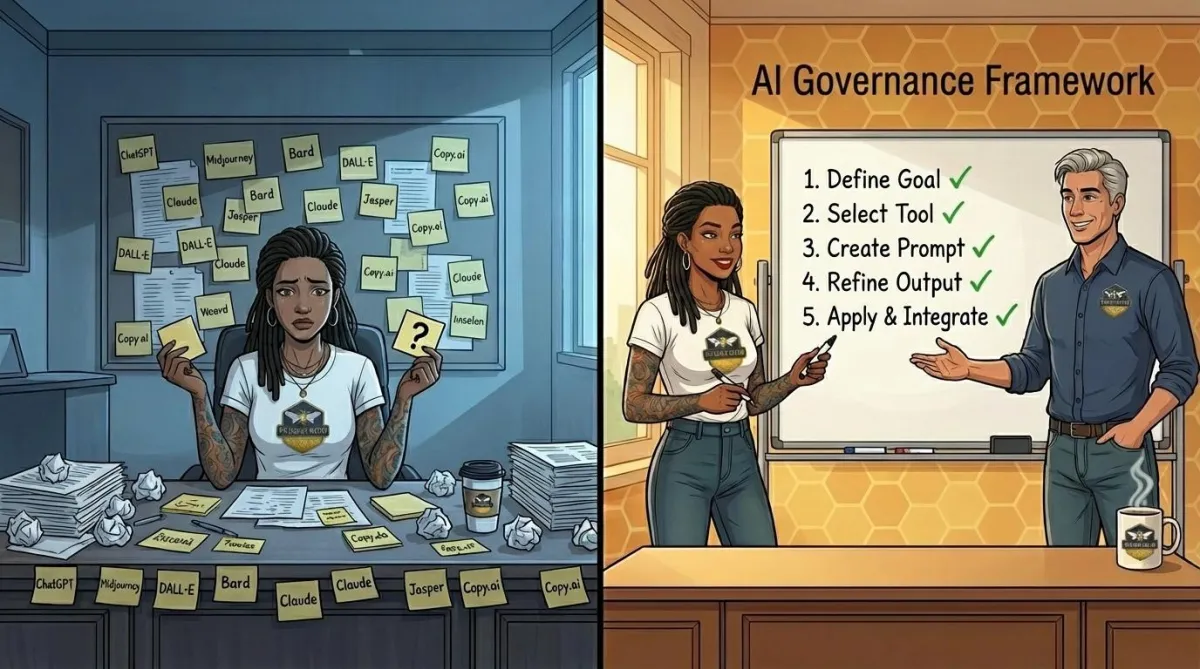
AI Governance Isn't Just for Corporations. Here's Your Small Business Version.
When you hear "AI governance," what do you picture?
A risk management committee. A 47-page policy document. A legal team. A dedicated compliance officer. Maybe a Fortune 500 boardroom with someone in a blazer saying, "We need to operationalize a framework."
Not your seven-person consulting firm. Not your insurance practice. Not your coaching business.
Here's the thing: that assumption is exactly why most small business owners are flying completely unprotected right now.
AI governance isn't a corporate luxury. It's just the decisions you're already making about how your business uses AI — except most of you are making them unconsciously, inconsistently, and without ever writing anything down.
That's the gap. And for professional services businesses with fewer than 10 people, it's a real vulnerability.
What Governance Actually Means at Your Scale
Let's strip out the corporate jargon for a second.
Governance, in practical terms, is just a set of agreements about how AI gets used in your business — what's in, what's out, who decides, and what happens when something goes wrong.
That's it. No committee required.
The reason it matters for small firms is actually more acute than it is for large corporations. When you have a compliance team of 200, one bad AI output probably doesn't sink you. When you have five people and 40 clients who trust you personally? One mishandled piece of client data, one AI-generated deliverable that was clearly not your voice, one automated email that went somewhere it shouldn't — that's a relationship problem. Potentially a business problem.
You're not too small for governance. You're too small to survive without it.
The 5 Non-Negotiables (Human-Sized Edition)
Here's what I've found, from building my own AI partnership systems and watching professional services owners navigate this space: governance doesn't have to be elaborate. It has to be intentional.
These five things are the floor. The minimum viable governance for a firm with fewer than 10 people.
1. A clear answer to: "What does client data touch?"
This is the one most people skip because it feels like a technical question. It's not. It's a trust question.
Before any AI tool enters your workflow, you need to know: Is any client-identifying information going into this prompt? Their name, their company, their financials, their challenges — does any of that travel into a third-party AI system?
Most AI platforms train on user inputs by default. Some have opt-outs. Some enterprise versions have data isolation. You need to know where yours stands, and you need a simple internal rule: what's off-limits for AI prompts, period.
"No client names in prompts" is a governance policy. It takes 30 seconds to write and protects you from a lot.
2. A designated "AI owner" in your business
Even if that owner is you.
Someone in your business needs to be the one who evaluates new tools, decides what to adopt, and understands how each tool handles data. In a seven-person firm, this might be the founder. In a two-person operation, it's definitely you.
The problem isn't that small businesses lack resources for this. The problem is that nobody has claimed the role, so AI adoption is happening by whoever feels like it. That's how you end up with four team members using four different AI tools, with zero consistency and oversight.
Name an AI owner. Even if it's you. It changes how decisions get made.
3. A "human review before it goes out" rule
I call this the Last Human Layer.
Every AI-generated output that leaves your business — client deliverable, email, proposal, report — gets a human review before it goes out. Always. No exceptions.
This isn't about distrusting AI. It's about maintaining your professional standards and catching the things AI consistently gets wrong: nuance, relationship context, tone calibration, anything that requires judgment only you have.
The rule isn't complicated. Write it down. Make it the expectation for everyone who uses AI in your business.
4. A list of "off-limits" use cases
Here's a list worth making in your business: the things that should never touch AI. Part of governance is knowing what AI won't touch in your business.
For most professional services firms, this includes things like:
— Initial consultation conversations (relationship-building is yours)
— Difficult client feedback or conflict resolution communication
— Anything where professional judgment or credentialed expertise is the actual deliverable
Your off-limits list might be different. That's fine. The point is having one — and communicating it to anyone on your team who uses AI.
5. A simple AI use disclosure approach
This one is still evolving in most industries, but the direction is clear: clients will increasingly expect to know whether AI touched their work.
You don't need a legal policy written by attorneys (though if you're in a regulated industry, you might want one eventually). You need a considered position.
What will you say when a client asks? What will you proactively disclose? How does your business talk about AI partnership in a way that's honest and builds trust rather than eroding it?
Having a prepared, thoughtful answer to "Do you use AI?" is governance. It signals that you've thought about this, that you're operating intentionally, and that your client's interests are part of your decision-making.
That's not a corporate compliance exercise. That's just how you protect a reputation you've spent years building.
The Real Reason Governance Matters at Your Scale
Here's what I keep coming back to: the professional services businesses I see using AI most effectively aren't the ones using the most tools. They're the ones using AI with the most intention.
Governance is just intention, written down.
You don't need a policy team. You need 30 minutes and a document that says: here's how we use AI, here's what we protect, here's who's responsible.
That document will do more to protect your client relationships, your brand, and your professional reputation than any tool upgrade you'll make this year.
Ready to stop wondering what an AI partnership could do for your business — and start building it?
Take the free AI Partnership Audit to find out where you are. Or, if you're a business owner ready to have your own AI brain trained to your voice — one you get to keep forever — work with me here.
3 Key Takeaways
1. AI governance isn't a corporate concept — it's just the decisions you're already making, written down. Every business using AI is already governing it, consciously or not. Making it intentional is what protects you.
2. Five non-negotiables for firms under 10: data boundaries, an AI owner, human review before delivery, an off-limits list, and a disclosure approach. None of these requires legal teams or policy committees. They require 30 minutes and a shared document.
3. At your scale, one AI misstep can cost you a relationship — not a statistic. The stakes for small professional services firms are personal in ways they aren't for large corporations. That's why governance matters more, not less.
Disclaimer: The experiences shared are personal results. Individual outcomes may vary. This content is for informational purposes only and does not constitute legal, financial, medical, psychological, or professional advice.


