Content Isn't Your Bottleneck—Operations Is
You know what I hear constantly from business owners who feel behind on AI?
"I just need to post more. I need more content. If I could just get my content game together, everything would click."
Here's the thing: Content isn't your bottleneck. Operations is.
And I say this as someone who spent way too long believing the opposite.
The Lie We've All Been Sold
Every AI tool marketed to small business owners right now is solving the same problem: content creation. Write more blogs. Generate more social posts. Pump out more emails. The message is clear—if you're struggling, you're not visible enough.
But here's what the data actually shows:
Business owners spend only 15-20% of their time on marketing and content creation. Meanwhile, they spend 40-50% of their time on operational tasks—client onboarding, proposals, follow-ups, internal coordination, and the endless decision-making that keeps them up at night.
When researchers asked small business owners what was blocking their growth, 62% cited internal systems and process inefficiency. Only 18% cited marketing output.
Read that again: 62% say it's operations. 18% say it's marketing.
So why is everyone selling you a faster way to write LinkedIn posts?
The "Content Debt" Problem
Here's a concept that changed how I think about this: Content debt.
Content debt occurs when your marketing outpaces your operations.
You post something that resonates. Leads come in. And then... they sit in your inbox for four days because you don't have a system to respond quickly. You finally send a proposal, but it takes you three hours to customize because you're building from scratch every time. The client goes quiet. You follow up—eventually—but by then, they've hired someone else.
That's not a content problem. That's a backend problem disguised as a sales problem.
More content into a broken bucket just makes a mess. If you 2x your leads but your proposal process is manual, you've just 2x'd your stress, not your profit.
The Front Stage vs. Back Stage Reality
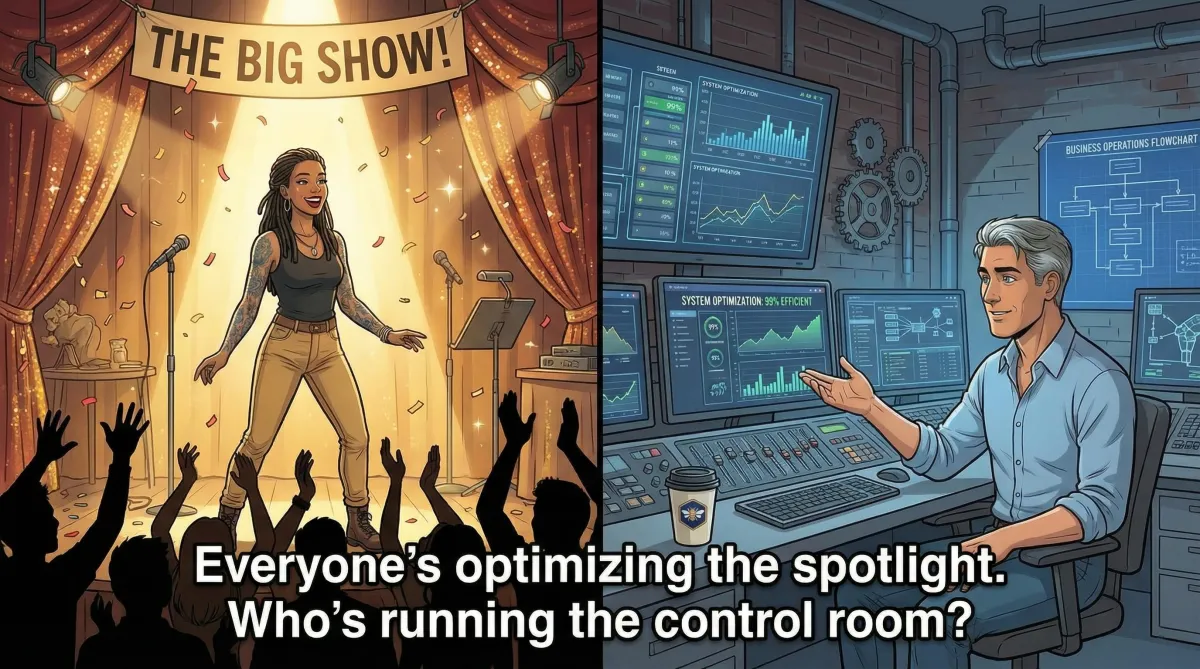
Think of your business like a theater.
Content is the front-stage—the performance, the lights, the audience-facing spectacle. It's what people see. It's sexy. It's easy to talk about.
Operations is the backstage—the lighting crew, the sound system, the logistics that make the show actually happen. Nobody sees it. Nobody posts about their "killer SOP for client onboarding."
But here's the truth: if your backstage is chaos, no amount of front-stage polish will save you.
You can have the most beautiful storefront in the world. If the kitchen is on fire, customers aren't coming back.
What This Means for Women and LGBTQ+ Business Owners
This hits differently for underrepresented founders.
Research shows that women business owners are 1.5x more likely to handle operational tasks themselves rather than delegate them. We're doing the "invisible work"—the client follow-ups, the proposal rewrites, the mental load of remembering every detail—while also trying to show up on social media like everything's fine.
And here's the equity angle nobody's talking about: Women face a 25% lower AI adoption rate than men in business settings. For women entrepreneurs, "opting out" of AI for operations isn't neutral—it's a risk of widening the gap you've spent your career trying to close.
AI for operations isn't about working harder. It's about finally having backup for the work nobody sees.
The Real Distinction: Content AI vs. Operations AI
Let me be clear: I'm not anti-content tools. Jasper, Copy.ai, ChatGPT for writing—they're great at what they do.
But they solve a narrow problem: how to create more output.
What they don't solve:
How to turn a discovery call into a proposal in 10 minutes instead of three hours
How to onboard a new client without manually setting up everything
How to triage 200 emails so you only see the ones that actually matter
How to make decisions faster when you're drowning in options
Content AI is your copywriter. Operations AI is your chief of staff.
Content AI helps you talk about your business. Operations AI helps you run your business.
Use both. But if you can only invest in one, invest in the thing that determines whether you can actually serve the clients your content attracts.
The Question That Changes Everything
Here's how you know if operations is your real bottleneck:
Could you onboard three new clients tomorrow without chaos?
If the answer is no—if new clients would break your current systems, overwhelm your capacity, or require you to work nights and weekends just to keep up—then your constraint isn't visibility.
It's infrastructure.
And that's what The Wilson Protocol™ actually solves. Not "how to write more content faster." But how to build the operational engine that makes growth sustainable instead of terrifying?
The Bottom Line
Content creates demand. Operations determine whether you survive it.
I went from 20 hours a week doing one marketing role to 30 hours performing the work of 8—and it wasn't because I started posting more. It was because I stopped trying to carry every operational task in my head and started building systems with an AI partner who could actually help me think, not just type.
That's the difference.
And it's the difference nobody's talking about—because "operations" doesn't sound as exciting as "10x your content in half the time."
But excitement doesn't pay your bills. Systems do.
Curious what an AI partnership could look like for your business? Take the free AI Partnership Audit, or join the Wilson Protocol Intensive for the full methodology.
3 KEY TAKEAWAYS
Operations is the real constraint, not content. Data shows 62% of small business owners cite internal systems as their growth blocker—only 18% cite marketing output. If your backend can't handle more clients smoothly, better content just accelerates burnout.
Content debt is real. When your marketing outpaces your operations, leads fall through cracks, proposals take days, and hot prospects go cold. More content into a broken bucket just makes a mess.
Content AI and Operations AI solve different problems. Content tools help you talk about your business. Operations AI (like the Wilson Protocol™) helps you run it. Use both—but invest first in the thing that determines whether you can actually serve the clients your content attracts.
Disclaimer: The experiences shared are personal results. Individual outcomes may vary. This content is for informational purposes only and does not constitute legal, financial, medical, psychological, or professional advice.


