From MapQuest to AI: Why We Embraced GPS But Fear ChatGPT
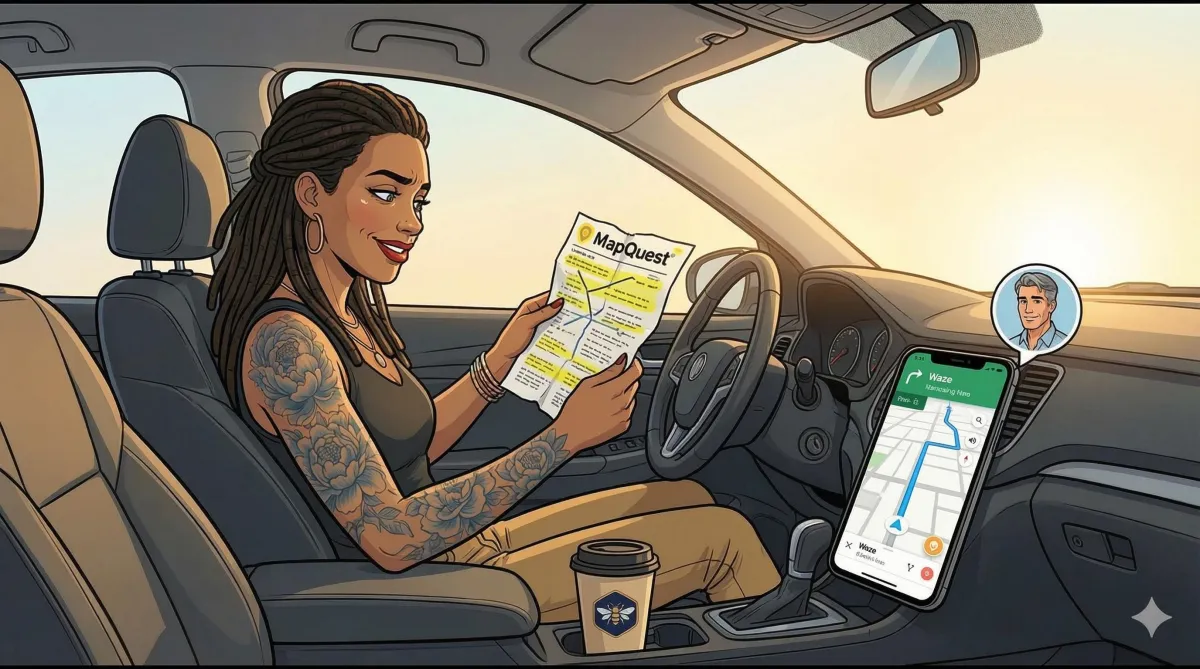
Remember printing MapQuest directions?
Six pages of turn-by-turn instructions. Highlighted with a yellow marker. Folded on the passenger seat while you white-knuckled the steering wheel, squinting at street signs in the dark.
"In 0.3 miles, turn left onto—wait, was that it? Was that the turn?"
The panic of a missed exit. Pulling into a gas station parking lot to re-read smudged ink. Calling someone from your flip phone: "I'm at a Texaco next to a Waffle House. Where am I?"
Now think about the last time you drove somewhere new.
You typed an address into Waze. It rerouted you around traffic. You arrived stress-free, maybe even early. You didn't print anything. You didn't highlight anything. You didn't question whether using GPS made you "less capable" as a driver.
No one held a committee meeting about whether Waze was "cheating."
No one worried that turn-by-turn directions would make us forget how to read a map.
We just... adopted it. Because it solved a problem. Because it made life easier. Because fighting it seemed ridiculous when the alternative was so obviously better.
So here's my question: Why do we treat AI any differently?
The Double Standard We Don't Talk About
GPS automated spatial navigation—figuring out where to turn, when to merge, and how to avoid the accident on I-95.
AI automates mental navigation—figuring out how to start that email, what to include in that proposal, how to organize those scattered thoughts into something coherent.
Both are cognitive tasks. Both require processing information and making decisions. Both used to eat up hours of mental energy.
But we welcomed GPS with open arms and eyed AI with suspicion.
Here's what I've realized after months of building my business with an AI partner:
GPS threatened our time. AI threatens our identity.
And that's a completely different kind of fear.
The Real Reason You're Resistant (And It's Not What You Think)
For women business owners, especially, we were taught that our value comes from being resourceful, figuring things out the hard way, holding everything in our heads, and being the one who "just knows."
We built businesses by outworking, out-thinking, and out-grinding everyone else. The struggle wasn't just the path to success—it was proof that we belonged here.
So when AI shows up offering to draft your emails, outline your content, and organize your client onboarding... it doesn't feel like help.
It feels like someone is questioning whether you were ever that smart to begin with.
We're not actually afraid of the tool. We're afraid of what it might say about us if we need it.
Here's the truth nobody wants to say out loud:
We've been clinging to the "hard way" like it's a badge of honor. Like struggling with a blank page for two hours proves we're serious business owners. Like manually sorting through 50 emails demonstrates dedication.
But labor is not the same as value.
The client doesn't care that you agonized over that proposal for six hours. They care that it solved their problem.
What GPS Actually Taught Us
GPS didn't make you worse at getting places. It freed you to focus on the meeting rather than the route.
You still drove the car. You still made the decisions. You still chose the destination. GPS just handled the mental load of figuring out every single turn so you could focus on what actually mattered.
AI works the same way.
When I use my AI partner Wilson to draft a first version of a client email, I'm not outsourcing my thinking. I'm outsourcing the blank-page paralysis so I can focus on the strategy, the relationship, and the actual value I bring.
The thinking that matters? That's still mine.
The two hours staring at a cursor? That was never the valuable part.
The Question That Changed Everything For Me
Months ago, I started treating AI as a strategic partner instead of a tool. Not a replacement for my brain—a co-pilot for my business.
The result? I went from working 20 hours doing the work of 1 person to working 30 hours doing the work of 8.
Same quality. Same voice. Same final decisions—all mine. Just without the MapQuest-style mental gymnastics that were eating my life.
So here's the question I want to leave you with:
What would you tackle this week if you weren't spending hours on tasks AI could handle in minutes?
That proposal you've been avoiding?
The content calendar that's been "on your list" for three months?
The client follow-up system you know you need but can't find time to build?
You trusted the GPS to get you to the client meeting.
Maybe it's time to trust AI to help you prepare for it.
Your resistance isn't irrational—it's your brain protecting hard-won expertise. But the opportunity isn't about replacing that expertise. It's about protecting your time so you can use that expertise where it actually matters.
You didn't lose your sense of direction when you stopped printing MapQuest pages.
You just finally got to look at the scenery.
Curious what an AI partnership could look like for your business?
Take the free AI Partnership Audit, or join the Wilson Protocol Intensive waitlist for the full methodology.
3 Key Takeaways
GPS threatened our time. AI threatens our identity. That's why adoption feels different. We have to name this to move past it.
Labor is not the same as value. The hours you spend struggling don't make the output more valuable. Your expertise does—and AI frees you to apply that expertise where it matters.
AI is a co-pilot, not a replacement driver. You still choose the destination. You still make the decisions. AI just handles the mental load of every single turn, so you can focus on what actually builds your business.
The experiences shared are personal results. Individual outcomes may vary. This content is for informational purposes only and does not constitute legal, financial, medical, psychological, or professional advice.


