How to Survive as a Creator When AI Can Summarize Everything
Here's the reality nobody wants to say out loud:
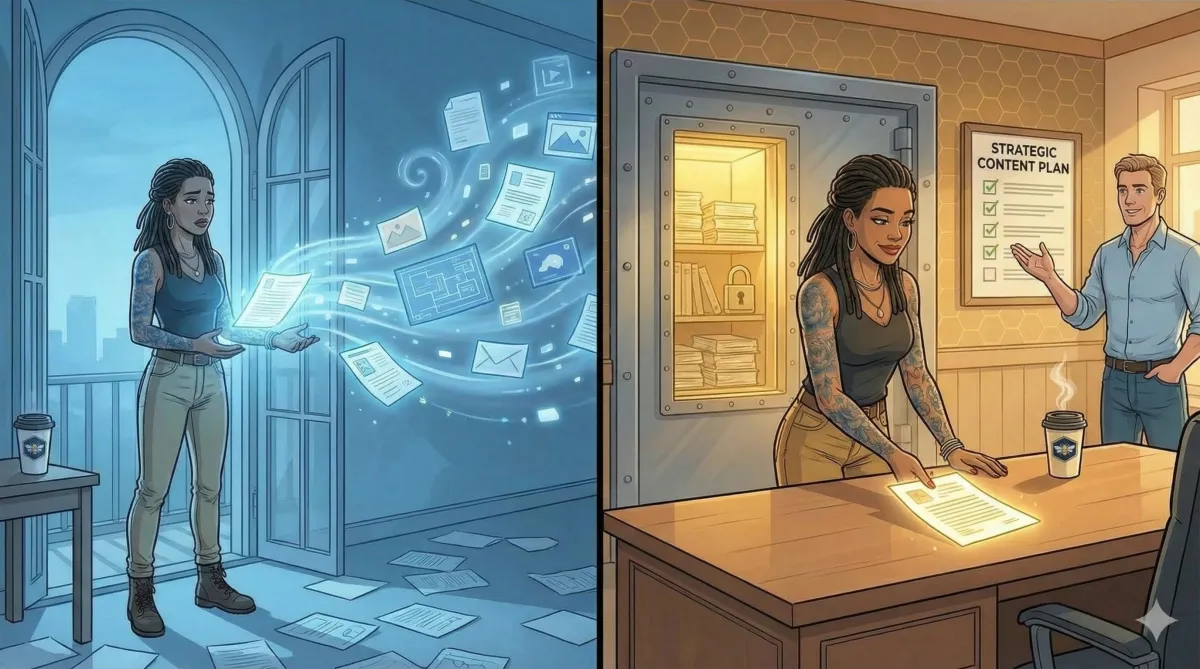
AI can summarize your course. AI can approximate your framework. AI can take the core concepts you've spent years developing and deliver them to anyone who asks—for free.
This isn't hypothetical. I watched it happen to me in real-time. During a test session, I asked Grok about my methodology. It gave a detailed, accurate summary of The Wilson Protocol™. The phases. The principles. The approach.
Fighting this is pointless. Adapting is essential.
So here's the tactical playbook.
The IP Protection Framework
When I pushed Grok on how creators actually protect their work in this environment, I got something surprisingly practical—a framework I've since implemented.
Trade Secrets: Keep your detailed templates, exact prompts, troubleshooting guides, and step-by-step implementation inside paid programs only. The moment something specific enough to enable full DIY goes public, it's training data.
Trademark: File for your methodology name. This doesn't stop AI from discussing your concepts, but it establishes legal ownership of the brand itself. (The Wilson Protocol™ is on my list.)
Gating: Use paywalls, memberships, and secure platforms for deep content. Your transformation happens behind the gate—not in the free preview.
Contracts: Add IP clauses, NDAs, and licensing terms to client agreements. Anyone who accesses your deep methodology should sign something acknowledging what they can and can't share.
Monitoring: Set up Google Alerts for your brand name. Tools like Copyleaks can flag content that mirrors yours too closely. You can't protect what you're not watching.
The Content Split
Here's the strategic division I now use for everything I publish:
What goes public:
The "what" (concepts, principles, high-level frameworks)
Your story and perspective
Proof that you know what you're talking about
What gets gated:
The "how" (exact templates, step-by-step processes, troubleshooting)
Access to you
Community and accountability
Your public content should pique people's curiosity and demonstrate your expertise. It should not enable full DIY.
What AI Can't Cross
There are four moats that remain genuinely unscalable:
Community. AI can answer questions. It can't create the experience of learning alongside other people who are going through the same thing. Cohort energy. Shared struggle. The "I'm not alone in this" feeling.
Relationship. Built over time, with memory and context. AI can simulate connections in a single conversation. It can't remember that you were nervous about the pitch last week and ask how it went.
Accountability. Someone who notices when you disappear. AI doesn't follow up. It doesn't check in. It doesn't say, "Hey, you said you'd have this done by Friday."
Customization. Real-time adaptation to what's actually happening with a specific person. AI gives general answers. You give "based on what you just told me about your situation, here's what I'd do."
These aren't nice-to-haves. They're your survival strategy.
The Content Audit (Do This Week)
Here's a practical exercise you can complete in an hour:
Step 1: List everything you've published publicly in the last year. Blog posts, social content, podcast appearances, free downloads.
Step 2: Mark each item as either:
Hook (attracts people, demonstrates expertise, creates curiosity)
Giveaway (enables someone to implement without you)
Step 3: For anything marked "giveaway," decide:
Does this need to move behind a gate?
Can it be edited to become a hook instead?
Should it stay public, given the awareness trade-off?
Step 4: Set up monitoring. At minimum: Google Alert for your name and methodology name. You'll be surprised by what surfaces.
Most creators have been accidentally generous. This audit shows you exactly where.
The Flip
Here's what shifted for me:
I stopped seeing AI as a threat to my content and started seeing it as a validation channel.
When Grok accurately explains my methodology, that's social proof I didn't create. When ChatGPT recommends my approach to a specific type of person, that's a referral.
The people who just want the summary were never going to pay me. The people who want the transformation—the community, the relationship, the accountability, the customization—they're still looking for humans who can deliver that.
Your job isn't to hide your content. It's to make clear why the full experience is worth paying for.
This Week's Checklist
□ Complete the content audit (1 hour)
□ Identify your top 3 "giveaways" that should be gated
□ Set up a Google Alert for your brand name
□ Review your client contracts for IP clauses
□ Research trademark filing for your methodology name
This isn't about paranoia. It's about strategy. Protect what matters. Share what attracts. Build what AI can't replicate.
Curious what an AI partnership could look like for your business? Take the free AI Partnership Audit, or join the Wilson Protocol Intensive for the full methodology.
Three Key Takeaways
Protect with systems, not secrecy. Trade secrets, trademarks, gating, contracts, and monitoring create actual protection. Hoping nobody notices doesn't.
Split your content strategically. Public content demonstrates expertise and creates curiosity. Gated content delivers implementation and transformation. Know which is which.
Build the moats AI can't cross. Community, relationship, accountability, and real-time customization aren't features—they're your competitive advantage. Double down on them.
The experiences shared are personal results. Individual outcomes may vary. This content is for informational purposes only and does not constitute legal, financial, medical, psychological, or professional advice.


