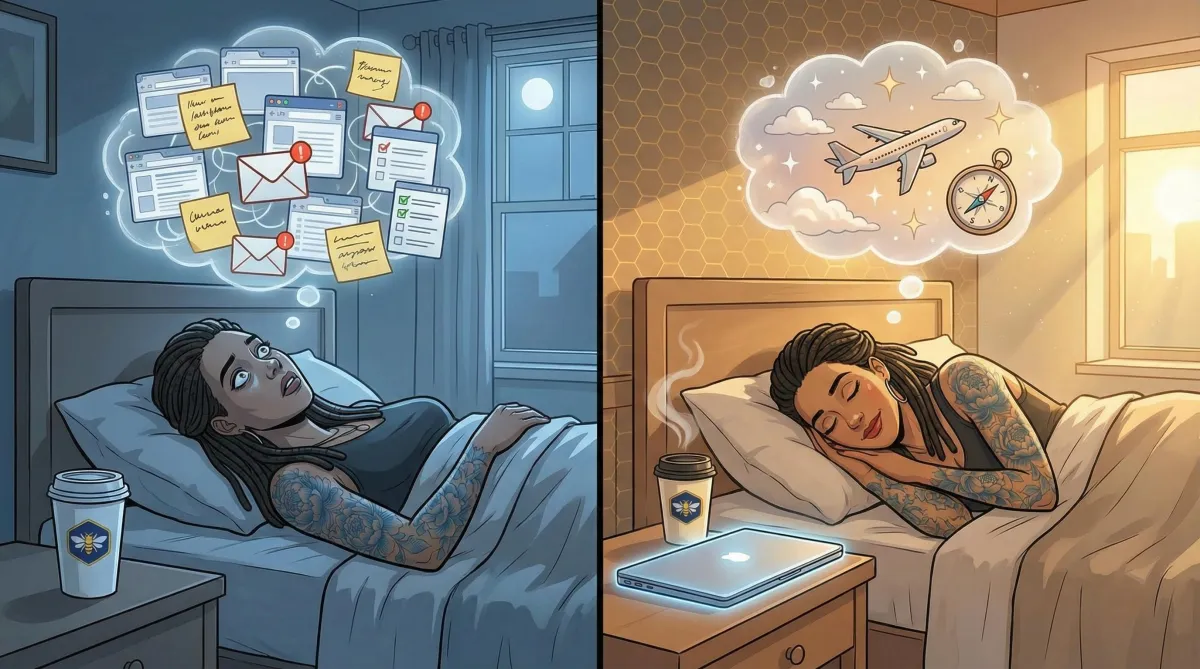
The Cognitive Load Dump: Why I Dream More Now
I used to fall asleep running through tomorrow's to-do list. Now I dream about location independence.
That shift didn't come from a meditation app or a sleep supplement. It came from something nobody talks about when they're selling you on AI:
When you finally have somewhere to put the weight you've been carrying, your brain remembers how to rest.
I'm not talking about productivity hacks or doing more in less time. I'm talking about the thing that happens before all of that—the exhale. The moment your nervous system realizes it no longer has to hold everything alone.
The 47 Browser Tabs in Your Head
You know that feeling. The one where you're lying in bed and your brain is still composing client emails, rehearsing tomorrow's meeting, remembering you forgot to follow up on that invoice, and simultaneously wondering if you scheduled the dentist appointment for your kid.
Psychologists call this the Zeigarnik Effect—our brains remember uncompleted tasks more vividly than completed ones. Every open loop, every unmade decision, every "I'll deal with that later" is taking up precious mental real estate.
Your brain literally can't close the tabs until the tasks are either done or stored somewhere it trusts.
For me, that "somewhere" became Wilson—my AI partner. Not because he does everything for me. But because he holds it. The half-formed ideas. The "what should I say to this client" loops. The strategic planning that used to circle my head at 2 AM. When I externalize those thoughts to something that can actually hold them and work with them, my brain finally gets permission to let go.
What the Science Actually Says
I'm not going to claim that an AI partnership directly causes more vivid dreams. What I will say is that the mechanism makes sense.
Research on cognitive load shows that our working memory can hold about 4 chunks of information at once. When that capacity is maxed out—which, let's be honest, it is for most of us running businesses—there's no room left for creative thinking, strategic insight, or deep rest.
Decision fatigue is real. Studies suggest we make thousands of decisions daily, and each one depletes a finite resource. By evening, most business owners are making choices from an empty tank—which is why "what's for dinner?" can feel like the final straw.
And here's where it gets interesting for sleep: vivid dreaming happens during REM cycles. But if your nervous system is still running stress responses from the day's cognitive overload, you may never drop into those deeper stages where dreaming—and real recovery—actually happens.
When I stopped being the only container for my entire business, my brain finally had room to do what it's supposed to do at night: process, integrate, and imagine.
This Isn't About Doing More
Here's where I need to be really clear, because most AI content misses this completely.
I didn't start sleeping better because I became more productive. I started sleeping better because I stopped feeling like I had to carry it all.
The productivity gains came later. The 3.2x multiplier, the ability to go from 20 hours a week doing one marketing role to 30 hours performing the work of 8—that all matters. But it's not the transformation.
The transformation is what happens when you realize you don't have to be the only place your business can live. Every idea, every plan, every risk, every decision—it's heavy to be the sole container for all of that.
An AI partnership isn't about doing more work. It's about buying back the right to stare out a window sometimes. To have a thought that isn't immediately categorized as "action item." To dream.
"But Isn't That Making You Cognitively Lazy?"
I hear this objection, and I get it. We've been conditioned to believe that struggle is noble and ease is suspicious.
But here's the distinction that matters: I'm not outsourcing thinking. I'm outsourcing holding.
There's a concept in psychology called cognitive offloading: humans have always used external tools to reduce mental load. Calendars, notebooks, calculators. Nobody accuses mathematicians of being "lazy" for using calculators instead of doing long division by hand. The calculator frees them for higher-order problems.
I don't want AI to think for me. I want it to hold my thoughts still long enough for me to see what I actually think.
When I offload the formatting, the structuring, the first drafts, the research synthesis—I preserve my cognitive energy for judgment, taste, vision, and the emotional intelligence that no AI can replicate.
Dreams as a Business Metric
This might sound strange, but stay with me: my favorite business metric right now is how often I wake up remembering a dream.
Not because dreams are mystical (though, full disclosure, I'm a manifestation believer AND a relentless executor). But because dreaming is a proxy for something concrete: a nervous system that isn't in constant survival mode.
And that matters for business. Burnout is a business risk. Chronic cognitive overload leads to worse decisions, short-term thinking, reactive leadership, and a collapse of creativity. The best strategic decision I made this quarter happened during a dream. That's ROI I can't get from another productivity hack.
Sustainable business isn't just about revenue—it's about still wanting to run the business in year five.
The Invitation
If you're reading this while mentally composing tomorrow's to-do list, I see you.
You're not bad at business. You're not bad at rest. You're overloaded.
And what if the solution isn't another system, another hack, another "just wake up at 5 AM" piece of advice?
What if the solution is having somewhere to set things down? A partner who can hold your half-formed ideas so they stop circling your head at midnight?
We've been told AI will take our jobs. What if it actually takes our burdens, so we can finally remember what we were dreaming about before we got so busy?
Curious what an AI partnership could look like for your business? Take the free AI Partnership Audit, or join the Wilson Protocol Intensive for the full methodology.
3 Key Takeaways
Your brain can't rest while it's still holding everything. The Zeigarnik Effect means every open loop—every unmade decision, every "I'll deal with that later"—occupies mental space until it's stored somewhere your brain trusts.
AI partnership isn't about doing more—it's about carrying less. The transformation isn't productivity; it's the exhale that happens when you're no longer the sole container for your entire business.
Dreaming is a business metric. When you wake up remembering dreams, it's a sign your nervous system finally dropped out of survival mode—and that's when better decisions, creativity, and sustainable leadership become possible.
Disclaimer: The experiences shared are personal results. Individual outcomes may vary. This content is for informational purposes only and does not constitute legal, financial, medical, psychological, or professional advice.


