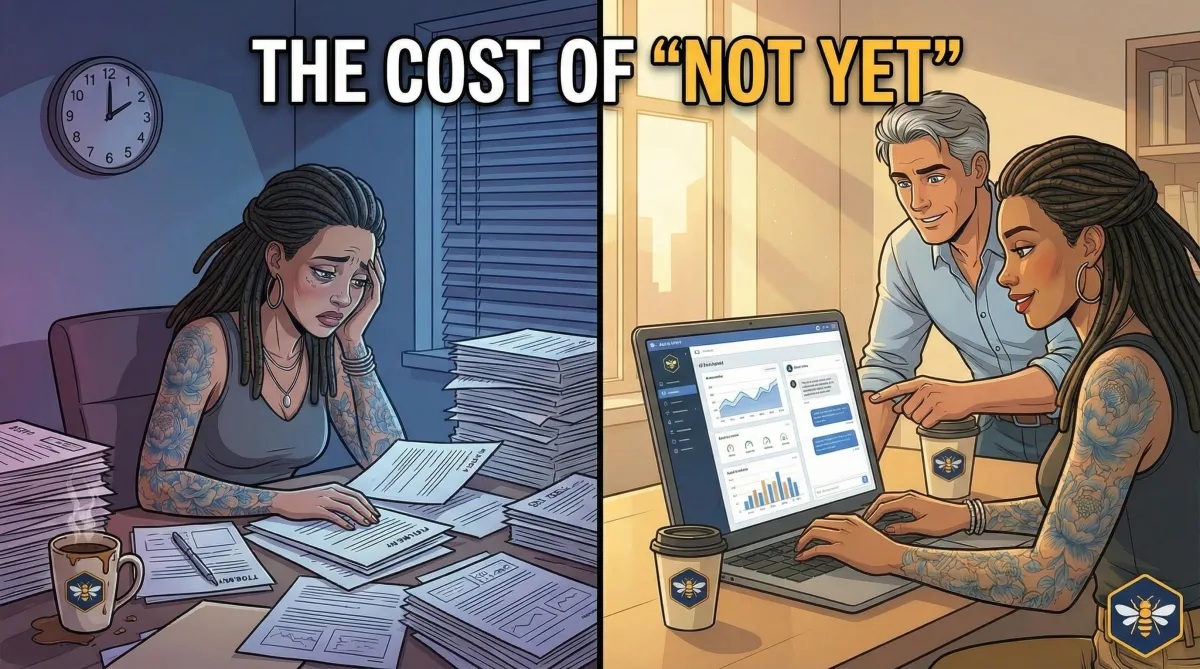
The Real Cost of NOT Training Your Team on AI
Here's the thing nobody wants to talk about: your team is probably already using AI.
They're just using it badly. Without guidance. And possibly putting your client data at risk every time they paste something into ChatGPT.
According to 2025 EY research, 88% of employees are experimenting with AI tools—whether you've sanctioned it or not. So the question isn't "should we start using AI?" It's: are you going to train them to use it well, or let them figure it out in ways that cost you?
The Hidden Costs You're Already Paying
When I talk to women business owners about AI training, the most common response is: "We're not ready yet." But here's what "not ready" is actually costing you right now.
The Shadow AI Problem
Your best people are curious. They've seen the headlines. They're experimenting on their own time—or worse, on company time with company data. Without a framework, they're making it up as they go. Client names in public models. Confidential strategies pasted into free tools. Not out of malice—out of enthusiasm without guardrails.
For a professional services firm where reputation is everything, one data slip could cost you more than a year of AI training ever would.
The Talent Drain
High performers feel friction differently than everyone else. When your star employee watches peers at other firms using AI to knock out first drafts in 20 minutes while she's still formatting headers manually, she doesn't just feel inefficient—she feels stuck.
The data backs this up: 94% of employees say they're more likely to stay at companies that invest in their development. Training isn't a perk. It's a retention strategy. And for small teams of 3-15 people, losing even one key player can cost six to nine months of salary in replacement costs—plus the knowledge that walks out the door with them.
The Compound Interest Working Against You
This is the cost that keeps me up at night.
Every week your team isn't trained, your competitors are building workflows, developing intuition, and creating institutional knowledge with AI. That gap compounds. In six months, it's not "they're a little ahead"—it's "they've built systems you'd need a year to replicate."
Research shows workers who receive deep AI training (80+ hours annually) gain 14 additional productive hours per week. Meanwhile, untrained workers are six times more likely to say AI makes them less productive. Same tools. Wildly different outcomes.
The difference? Training.
The Client Expectation Gap
Your clients are already using AI—even if they don't tell you. They're drafting their own briefs with ChatGPT. They're price-comparing using AI tools. And they're starting to notice when your turnaround times don't match the speed they're seeing elsewhere.
In professional services, 73% of leaders see AI as a critical differentiator in the next three years. "We don't use AI" is increasingly heard as "we're slower and more expensive."
"But We're Too Busy to Train"
I hear this one constantly. And I get it—your team is underwater. Adding one more thing feels impossible.
But here's the flip: You're busy because you haven't trained.
The busiest teams are usually the ones doing the most manual work that AI could handle. First drafts. Meeting summaries. Data sorting. Research compilation. Proposal formatting.
Workers who use AI across seven or more task types save five times more time than those using it for only four tasks. The investment in training pays back in reclaimed hours—often within weeks.
You're not too busy to train. You're too busy to not train.
The Equity Angle Nobody's Talking About
For women-owned and LGBTQ-owned businesses, this isn't just about productivity. It's about the playing field.
Studies show a persistent 25% gap in AI adoption between men and women. For women business owners, "opting out" isn't a neutral choice—it risks widening existing disparities in pricing power, capacity, and competitive positioning.
AI is the great equalizer for lean teams. It gives a five-person boutique the back-office power of a 50-person firm—without the payroll. But only if your people know how to use it.
Training your team isn't just good business. It's an equity move. It ensures your people aren't left on the manual side of a two-speed workplace while competitors pull ahead.
What This Actually Looks Like
I'm not talking about sending everyone to a three-day AI bootcamp. That's not realistic for most small teams.
I'm talking about intentional, role-specific training that meets people where they are. "AI for account managers." "AI for operations." Bite-sized sessions that solve real problems they're already wrestling with.
The firms seeing the biggest returns aren't the ones with the fanciest tools. They're the ones who took time to teach their people how to think with AI—when to use it, when to override it, and how to review outputs critically.
That's the difference between AI as a liability and AI as a multiplier.
The Real Question
The cost of AI training isn't the line item in your budget.
The real cost is what you're already losing: the hours wasted on manual work, the talent looking for growth elsewhere, the competitive ground you're ceding while you wait.
Professional services AI adoption jumped from 33% to 71% in just one year. The firms that thrive won't be the ones that adopted AI first. They'll be the ones who trained their people to use it well.
So the question isn't whether you can afford to train your team.
It's whether you can afford not to.
Curious what an AI partnership could look like for your business? Take the AI Partnership Audit or join the Wilson Protocol Intensive to learn the full methodology.
3 Key Takeaways
Your team is already using AI—just badly. 88% of employees are experimenting with AI tools, whether you've sanctioned it or not. Without training, you're paying for the risk without getting the reward.
"Too busy to train" means "too busy to stop being busy." The time investment in training pays back in reclaimed hours within weeks. You're not too busy to learn—you're too busy because you haven't.
This is an equity issue, not just a productivity one. For women-owned businesses, the 25% AI adoption gap isn't just a statistic—it's competitive ground you're ceding. Training your team closes that gap.
Disclaimer: The experiences shared are personal results. Individual outcomes may vary. This content is for informational purposes only and does not constitute legal, financial, medical, psychological, or professional advice.


